Factory or Trading Company? What Filter Buyers Should Know
A US buyer got a lower price through a trading company than the factory's direct quotation — and no single factory could quote a 2,000-item filter list alone.
"Are you a factory or a trading company?"
After six years in international trade, I understand why buyers ask. Buying directly from a manufacturer seems to mean fewer intermediaries, lower prices, and easier communication.
My experience has been more complicated. Before entering the aftermarket filter business, I worked for a manufacturing company. Some of the lessons I learned there still influence how I handle filter sourcing today.
Short answer: neither label guarantees a better deal. I have seen an American buyer get a lower price through a trading company than the factory's own quotation—and a 2,000-item filter inquiry that no single factory could quote alone. The useful question is not "factory or trading company," but whether the complete offer works: suitable products, competitive total cost, workable terms, and responsible follow-through.
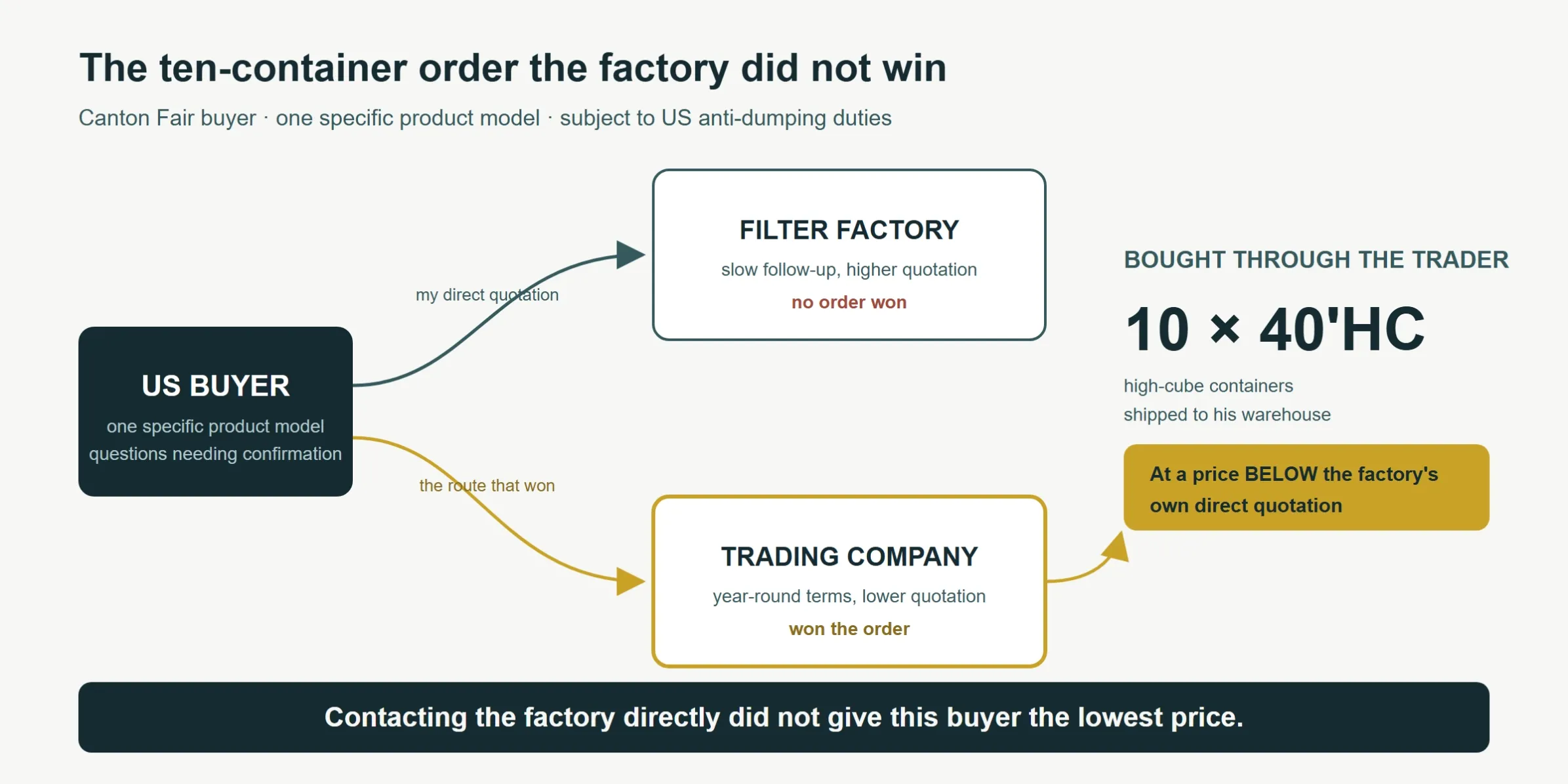
The most memorable involved a customer who bought our factory's products through a trading company—at a lower price than my direct quotation.
Ten Containers—and an Order I Did Not Win
I met an American buyer at the Canton Fair. His requirements were clear: he wanted one specific product model.
At the time, the product was subject to anti-dumping measures in the United States. He had questions about the transaction, and many required confirmation within our company.
I would collect his questions, speak with colleagues, and return with answers. When further questions came up, the process started again. I was actively following up, but progress was slow.
Then, during a video call, I noticed products carrying our brand in his warehouse.
He told me he had purchased ten 40-foot high-cube containers through a trading company. The price was lower than the quotation I had offered from the factory.
I did not know every detail of the trader's agreement, so I cannot attribute the difference to one factor. But one thing was clear: contacting the factory directly had not given this buyer the lowest price.
Purchasing Relationships Can Matter More Than Supplier Labels
During my time there, trading companies accounted for more than 70% of the company's export sales.
These were established customers bringing repeat business. Opening our own export department did not reduce their importance.
Occasionally, a trader's customer approached us directly, hoping to bypass the intermediary. Our boss would not allow us to quote.
For the factory, protecting a long-term sales relationship mattered more than winning one direct order.
Purchasing terms also differ. A new buyer may be discussing one order, while an established trader may purchase throughout the year. Stable volume and reliable payments can support better prices, rebates, or other commercial terms.
A trader can therefore add a margin and still offer a competitive price. This does not happen in every transaction, but it explains why "factory direct" is not a guarantee of the lowest quotation.
What About Operating Costs?
Manufacturing requires substantial investment in equipment, workshop operations, workers, raw materials, and inventory. A trading company usually has fewer fixed assets and a leaner operating structure.
However, the trader's purchase price already includes the manufacturer's production costs. Lower overhead alone does not make a trader cheaper.
The final price depends on purchasing terms, order requirements, operating efficiency, and the margin each supplier needs. A factory selling directly overseas also has to fund its export team, marketing, communication, and after-sales service.
The useful comparison is between complete quotations under comparable conditions—not simply between two types of company.
Direct Contact Does Not Always Mean Fast Decisions
One of the biggest challenges I experienced in factory work was internal coordination.
Production, finance, warehouse operations, and export sales each had their own responsibilities and procedures. Colleagues outside the export department did not always understand why an overseas customer needed a particular arrangement.
Yet international orders involve interconnected steps: payment, production scheduling, booking, loading, shipping, and customs clearance.
A loading-date change may be needed to meet a shipping cutoff. A document amendment may be necessary for customs clearance. A split shipment may help the customer manage inventory.
The salesperson must explain these needs internally and obtain agreement before replying.
The customer speaks with one person, but the decision may depend on several departments.
Experienced export manufacturers can manage this well. However, setting up an export department does not automatically make the entire organization ready to handle international business efficiently.
A Filter Inquiry with More Than 2,000 Items
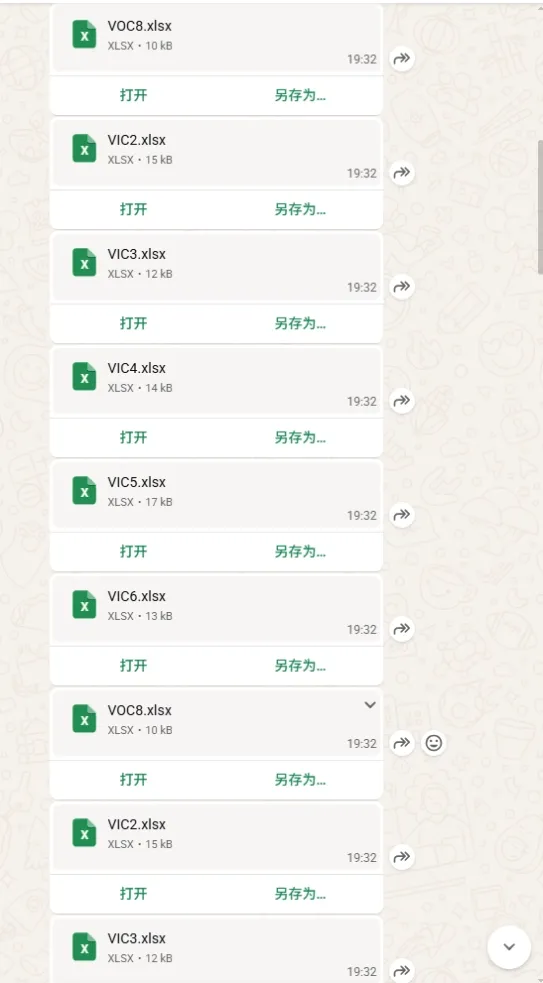
In my current aftermarket filter business, a South African customer sent eight Excel files containing more than 2,000 items. Additional inquiries were arriving daily.
I initially sent the complete lists to several partner factories. None could quote the entire requirement.
For a manufacturer, reviewing thousands of part numbers can require considerable work before an order is even confirmed. Many items may also fall outside its production range.
I then worked through the lists and sent the relevant items to different factories according to their product coverage. Replies came back much faster, and I sent the available quotations to the customer within 24 hours.
This was not a complete quotation for every item, and it did not mean every cross-reference had been verified. Outstanding prices and technical checks still needed follow-up.
But it demonstrated a practical role for a filter trading company: making a broad inquiry manageable and coordinating the responses.
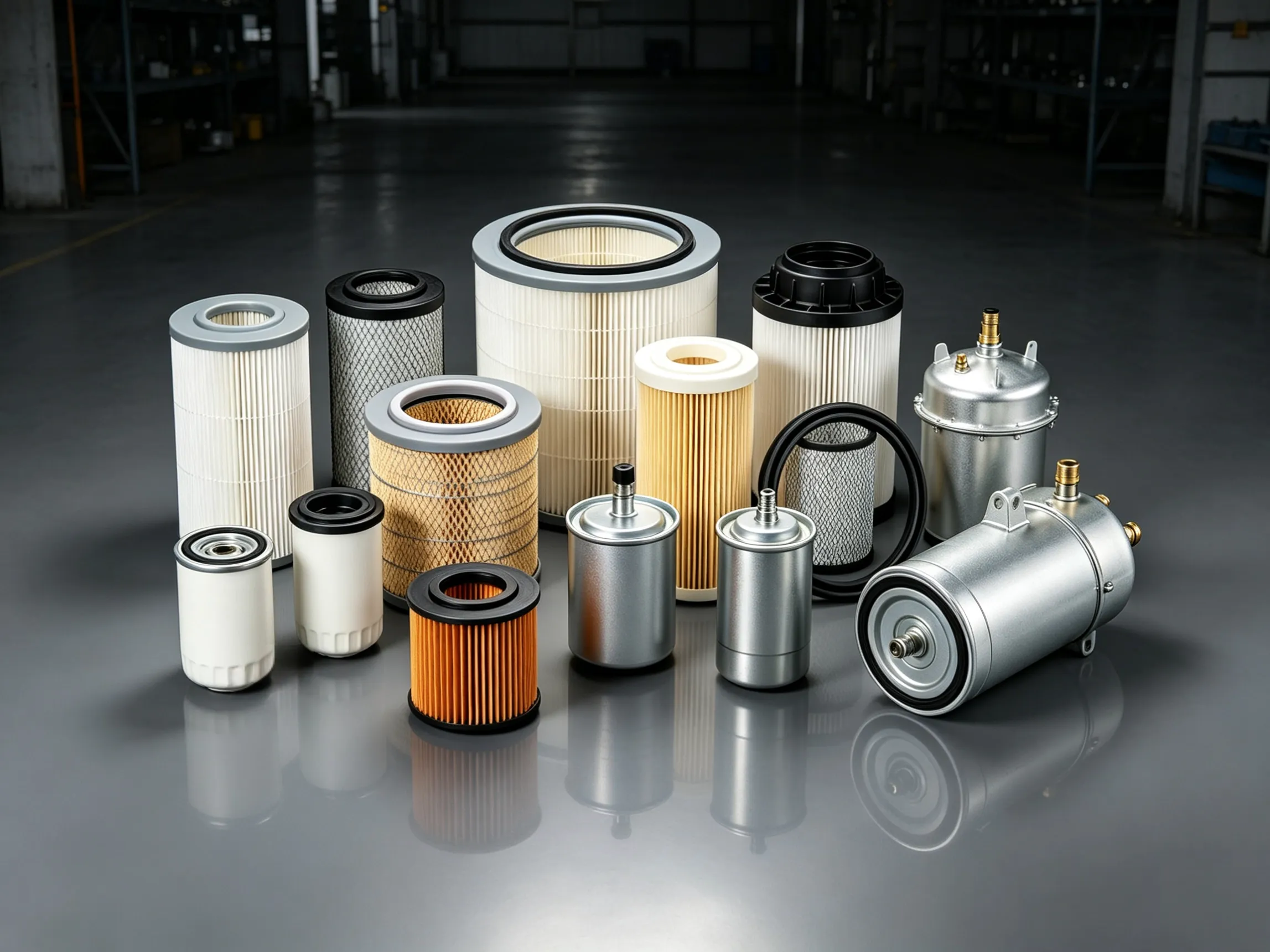
A heavy-duty filter order may include oil filters, fuel filters, fuel water separators, air filters, hydraulic filters, and coolant filters for different equipment. One factory may not be the best source for all of them.
Flexibility Is Part of the Offer
An order must work commercially as well as technically. Depending on the transaction, a trading company may be able to coordinate mixed orders, consolidate goods from different factories, compare shipping ports, or arrange partial deliveries.
Payment and collection options may also be more flexible, depending on the relationship, risk assessment, and applicable requirements.
These arrangements have costs and limitations. Their value lies in whether they help the buyer complete the purchase efficiently.
For a buyer ordering multiple filter types in smaller quantities, consolidation may simplify purchasing and shipping. For another buyer, a large order from one manufacturer may be more economical. The right arrangement depends on the actual order.
Factory vs. Trading Company: A Quick Comparison
So, is factory direct always the cheapest option? No. As the cases above show, the final price depends on purchasing terms, order requirements, operating efficiency, and the margin each supplier needs—not on the business label. What the two models differ in is where each tends to be strong:
Aspect | Buying factory direct | Buying through a trading company |
|---|---|---|
Unit price | Strongest for stable, repeat volume within its product range | Can match or beat factory quotes for a new buyer's first orders—established traders may hold better terms and rebates |
Product range | Limited to what it manufactures | Broad; oil, fuel, air, hydraulic, and coolant filters coordinated across factories |
MOQ and mixed orders | Set per model and production run | Mixed orders, consolidation, and partial deliveries across factories |
Technical access | Direct line to engineers for specifications, design changes, and failure analysis | Depends on the company's verification process and factory relationships |
Communication | One contact, but decisions may require internal sign-off across departments | One contact for commercial answers; technical answers still come from factories |
After-sales accountability | Direct with the manufacturer | Depends on the sourcing company's stated process—define it before ordering |
Neither column wins by default. The right question is which column fits the order you actually place.
When a Filter Manufacturer Is the Better Choice
If you regularly purchase large volumes from a focused product range, direct cooperation with a capable filter manufacturer may offer strong cost and production-planning advantages.
Direct technical access is also valuable for product development, material selection, design changes, and investigating manufacturing issues.
Whichever supplier you choose, replacement filter selection requires care. A cross-reference number is a starting point; dimensions, seals, filtration specifications, valve settings, and application requirements may still need confirmation.
A supplier should be able to explain both what has been verified and what requires further checking.
Frequently Asked Questions
Is it cheaper to buy directly from a filter factory?
Not always. A factory's best prices usually go to established customers who buy steadily throughout the year and pay reliably. A new buyer negotiating a single order may receive a higher price than an experienced trading company with volume commitments and rebates—which is what happened when one buyer purchased ten containers of our products through a trader at a price below the factory's direct quotation. The reliable method is to compare complete quotations under the same conditions: identical products, quantities, terms, and delivery basis.
When is a trading company the better choice for filter buyers?
When the order covers products that no single factory manufactures. We received an inquiry of eight Excel files with more than 2,000 items; none of our partner factories could quote the full list. Splitting it by product coverage produced available quotations within 24 hours. A trading company can also consolidate mixed orders from different factories into one shipment, which simplifies purchasing and freight—especially for buyers ordering multiple filter types in smaller quantities.
Who is responsible for filter quality when buying through a trading company?
Responsibility should be defined before the order, not after a problem appears. A sourcing company should be able to tell you what has been verified—dimensions, seals, filtration specifications, valve settings—and what still needs confirmation against your application, and explain how a claim would be handled and who coordinates with the manufacturer. If a supplier cannot answer that clearly, the factory-versus-trader question is the least of your concerns.
Look Beyond the Business Model
"Are you a factory or a trading company?" is a reasonable opening question. The next questions are more revealing:
- Which products and applications do you know best?
- How do you confirm replacement suitability?
- What is included in the price and delivery commitment?
- Can you support my order quantities and shipping requirements?
- Who handles problems after the order is placed?
At NAKATU, we focus on sourcing replacement filters for heavy-duty equipment, coordinating manufacturing resources, and clearly communicating availability and details requiring further verification.
If you have a mixed filter inquiry, you can send us your part numbers, quantities, and application details—one list, one contact. We can review the list and explain what we can quote and what needs further checking.
The right supplier should be judged by the complete offer: suitable products, competitive total cost, workable terms, and responsible follow-through.